
Buildings Will Be More Solid with Smart Column
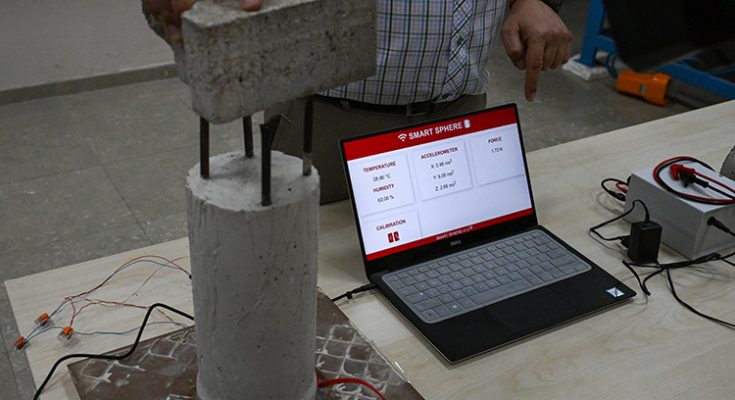
Following the 5.7 and 5.9 magnitude earthquakes that occurred in Izmir in 2005, Prof. Dr. Serhan Özdemir, a faculty member at the Mechanical Engineering Department of the Faculty of Engineering at Izmir Institute of Technology (IZTECH), started working on determining the durability of buildings and conducted a “building trauma index” project with the support of academics at the civil and computer engineering departments of the university.
In the system, which has been patented and successful results have been achieved in a laboratory environment, data obtained from temperature, acceleration, humidity and force sensors placed inside the columns are transferred to the computer via a wireless connection. This data, which includes the trauma memory of the buildings, can be processed and a “trauma index” that will show the durability can be created.
It is envisaged that the trauma index, which will provide information about the health of the columns that hold the buildings upright, will also be monitored by local governments and relevant ministries.
Prof. Dr. Özdemir told AA correspondent that with the development of technology, many objects have become “smart” but there is no method of communicating with buildings.
Özdemir, who pointed out that the detection of defects and damage in buildings can only be done by looking from the outside or by damaging the concrete, said, “At that moment, we realized that the buildings were not actually talking to us. We set out thinking that we needed to make the buildings talk.”
Özdemir, who stated that they focused on laboratory studies after the idea of monitoring the structure with a system embedded in concrete emerged, said, “We created an index that included humidity sensors, acceleration sensors to detect earthquakes, corrosion sensors to see corrosion in iron and a parameter to measure age in this unit we placed inside the concrete. We named it Building Trauma Index BITEX. I hope it will be universal and spread all over the world. Our wish is for buildings to talk to us from now on. The instant temperature, humidity, corrosion and force information on the columns will start to flow to computers or mobile phones if you wish.”
Prof. Dr. Özdemir stated that the system involves placing spheres containing a series of sensors at different points of the columns during the construction of the building, and that a wireless system has also been designed for data flow from the sensors.
Özdemir explained that thanks to the sensors, the events that the building experiences will be memorized and said:
“If you look at the history of that building, if the humidity data is stable, it means there is no problem. However, if there was a sudden increase in the humidity data of that column two or three years ago, it means that the place was flooded. If there is a temperature that reaches 300-400 degrees in that column for a very short time, we will understand that that building has a fire history. Those who are going to buy property from that building will be able to make a decision by looking at this potentially traumatic history. Strength will be a very important parameter. It is important in terms of illegal floors and the problems of the building’s column being cut. Changes in the load carried by the column can be seen with the sensor. The increase in load will mean that there is an illegal floor. When the column is cut, the incoming data will suddenly disappear.”
Özdemir also stated that the system includes instant transmission of data to the local government and the relevant ministry, and that the trauma history of a building can be seen without going near that building.
Prof. Dr. Özdemir, drawing attention to the fact that Turkey is a high-risk country in terms of earthquakes, emphasized that the implementation of this system is important for monitoring the condition of buildings.
Özdemir stated that from time to time, attempts are made to cover up the traces of traumas such as earthquakes, floods and fires with methods such as plaster and paint, and said that the system will also be a solution to this.
Underlining that their goal is to prevent loss of life, Özdemir said, “When we take into consideration the unfortunately painful experiences that earthquakes remind us of, we see that we need to continue this new century with a new mentality.”
Özdemir stated that the system would not add a serious burden to the building cost and that it could cause an increase of 1-2 percent, and added that the system, which was successful in a laboratory environment, needed to be tested in real buildings in order to be put into practice, and that they were expecting support for the project due to the cost of the work.